
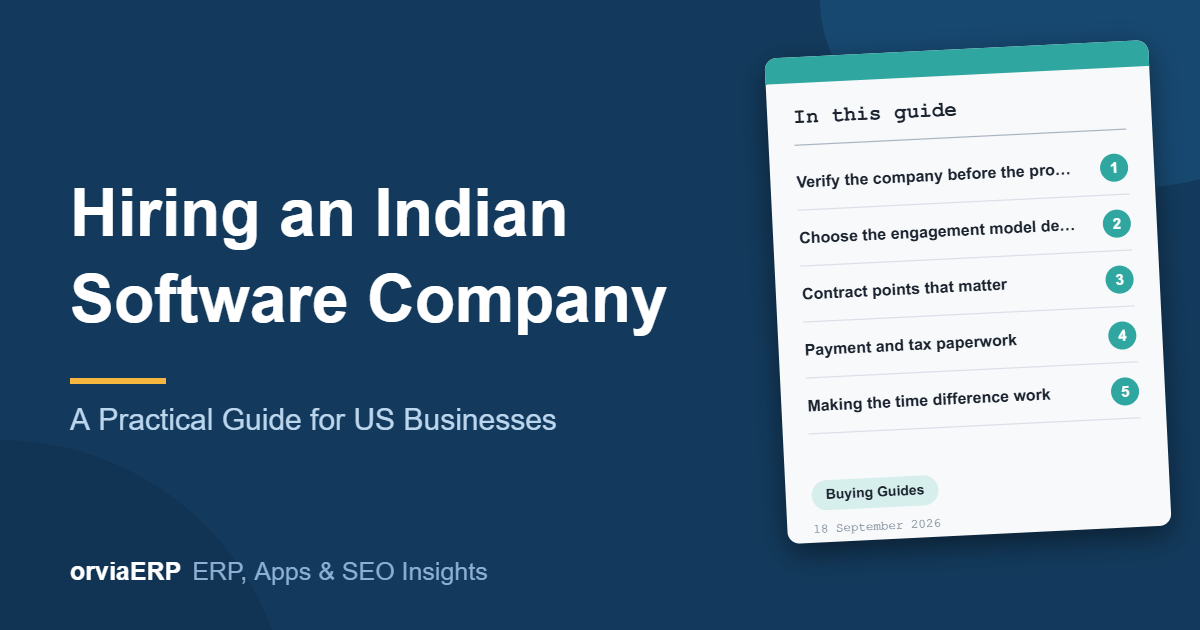
If you are searching for how to hire an Indian software development company for your US business, you are probably short of senior engineering capacity, unable to wait six months to hire it, and in need of a team that can start next month. This guide covers how to vet an Indian development partner, structure the contract, handle the tax paperwork and make the time difference work, before you sign anything.
Why US companies hire Indian software partners
Most US companies that hire an Indian software partner are not chasing a lower hourly figure. They need senior capacity quickly, they want a team that can start within weeks, and they would rather not carry the cost and delay of a full US hiring cycle.
The risk is not the geography. It is buying from a firm that cannot be held accountable. The checks below separate a real partner from a reseller.
Step 1: Verify the company before the proposal
Do this before you spend time on a proposal. It takes under an hour.
- Ask for the CIN (Corporate Identification Number) and look it up on the Ministry of Corporate Affairs portal. It is public and free.
- Ask for the GSTIN and verify it on the GST portal. Confirm the registered address matches the office named in the proposal.
- Ask who will actually do the work. How many people are employees, how many are contractors, and is any work subcontracted onward?
- Ask for two references you can call, ideally in your industry, and for live products they built, not screenshots.
A genuine firm answers these quickly and without discomfort. Hesitation is information.
Step 2: Choose the engagement model deliberately
| Model | Best for | Who carries the risk | Watch out for |
| Fixed-scope, fixed-price build | A clearly defined product | The vendor carries delivery risk | Changes are priced separately |
| Dedicated team | A long-running product with shifting requirements | You carry the direction risk | Open-ended spend if scope is not managed |
A fixed-scope, fixed-price build suits a clearly defined product: you approve a written scope, the vendor carries the delivery risk, and changes are priced separately. A dedicated team suits a long-running product where requirements keep moving, and you carry the direction risk instead.
Neither is better. The mistake is using a dedicated-team model for a defined project, which turns an unknown scope into an open-ended bill.
Step 3: Get the contract points that matter
Have your US counsel review the final agreement. At minimum, it should include:
- Written assignment of intellectual property to you on payment, covering source code, designs and documentation.
- A mutual NDA signed before anything sensitive is shared.
- Governing law and dispute resolution stated explicitly, including where any arbitration would sit.
- Milestone-based payment tied to written acceptance criteria, rather than large upfront payments.
- Source code, hosting, domain and analytics accounts registered in your company name, not the vendor's.
The last point is the one most often skipped, and the one that causes the most painful disputes later.
Step 4: Understand payment and tax paperwork
This section is general information, not tax or legal advice. Confirm your own treatment with your tax adviser before the first payment.
- Exported software services are zero-rated under Indian GST, so a compliant export invoice carries no Indian GST.
- Payment is normally by international wire.
- US companies paying a foreign vendor are commonly asked to collect a Form W-8BEN-E from the vendor, and services performed outside the US are generally treated as foreign-source.
Ask the vendor to explain their export invoicing and payment process in writing. A firm that works with overseas clients regularly will have it ready.
Step 5: Make the time difference work
India is 9.5 to 10.5 hours ahead of US Eastern time, depending on daylight saving. Real overlap is a few hours at the start of your day, which is the end of ours.
That is enough if you insist on three things:
- A named project manager with a committed response window.
- A written update after every milestone.
- A standing weekly call at a fixed time.
Without them, the gap turns every question into a 24-hour round trip. With them, the time difference becomes an advantage: work done overnight is waiting for you each morning.
Red flags to walk away from
- A detailed quote produced within an hour for a complex brief
- Reluctance to name the people who will build your product
- No written scope, only a proposal deck
- A request for a large payment before any scoping is done
- Hosting and domain registered to the vendor
One red flag is a question to ask. Two or more is a reason to stop.
A quick checklist before you sign
- CIN and GSTIN verified, address matches
- Team composition and subcontracting disclosed
- Two references called, live products seen
- Engagement model matches the type of project
- IP assignment, NDA, governing law and milestone payments in the contract
- All accounts registered in your company name
- Project manager, update rhythm and weekly call agreed
- Export invoicing and tax paperwork confirmed with your adviser
How ORVIA works with US clients
ORVIA builds custom ERP software, web applications, mobile apps and UI/UX design. Around a third of our work is for clients outside India, including the United States, and our USA market page explains how we handle state sales tax, QuickBooks and Stripe integration.
In practice that means a written scope and fixed price before work starts, calls scheduled in your morning, one named project manager reachable on WhatsApp and email, and source code, hosting and accounts registered in your name. We sign an NDA before you share anything sensitive, and invoices are raised in USD as compliant export invoices. You can read more about our approach on the About page, see our work and case studies, and review how we handle confidentiality on the Security & NDA page.
We would also encourage you to apply the checklist above to us, or to any firm you consider.
Frequently asked questions
Is it safe to hire an Indian software development company?
It is safe when you verify the company, get a written scope, tie payments to milestones and keep ownership of your code and accounts. The risk comes from unaccountable vendors, not from the country.
Should I choose a fixed-price or a dedicated team model?
Choose fixed-price for a clearly defined product and a dedicated team for a long-running product with changing requirements. Using a dedicated team for a defined project often leads to an open-ended bill.
Who owns the intellectual property?
It should be assigned to you in writing on payment, covering source code, designs and documentation. Do not rely on a verbal understanding.
Do I pay Indian GST on software services?
Exported software services are zero-rated under Indian GST, so a compliant export invoice carries no Indian GST. Confirm your own US tax treatment with your tax adviser.
How do I work across the India and US time difference?
Insist on a named project manager, written updates after every milestone and a fixed weekly call. A few hours of overlap at the start of your day is enough when these are in place.
What documents should I ask a vendor for?
Ask for the CIN, the GSTIN, the registered address, two reference contacts, examples of live products and a clear statement of who will do the work and whether any work is subcontracted.
Final thoughts
Hiring an Indian software partner works well when you treat it like any serious vendor decision: verify the company, pick the right engagement model, put the key protections in the contract, and set a communication rhythm that survives the time difference.
Do the checks before the proposal, not after. They take an afternoon and can save you a year.
Planning a software project and want an honest second opinion? Talk to ORVIA or call +91 91225 05250, or email hello@orviaerp.com.