
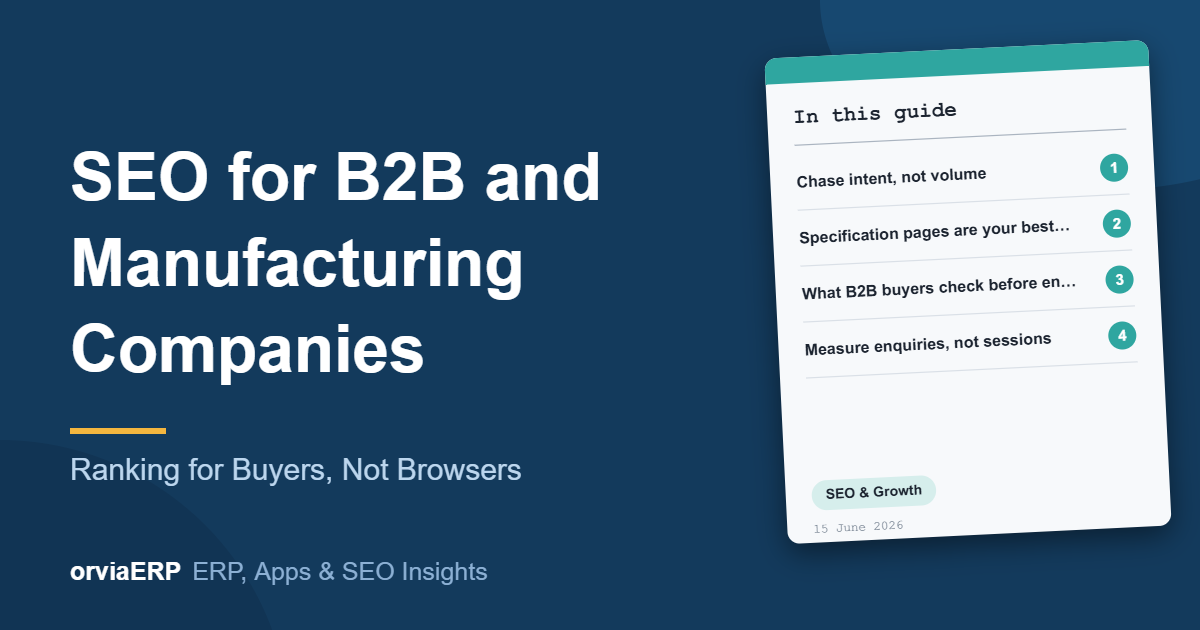
If you have been searching for SEO for manufacturing companies and the advice sounds like it was written for an online shop, that is because most of it was. B2B SEO fails when it is measured like B2C SEO.
A manufacturer does not need fifty thousand visitors. It needs the two hundred procurement managers who search a specific part specification each month. This guide shows how to build a site that ranks for those buyers: target intent instead of volume, publish specification pages, answer the questions buyers ask before they enquire, and measure the numbers that matter.
Chase intent, not volume
A keyword with 90 searches a month and clear purchase intent is worth more than one with 40,000 and none.
| Keyword | What the searcher wants | Worth targeting? |
| industrial water chiller | Research, definitions, general information | Later, as supporting content |
| water cooled screw chiller 50 TR price | A specific product, ready to enquire | Yes, build a page for it first |
"Industrial water chiller" is a research term. "Water cooled screw chiller 50 TR price" is a buyer. Build pages for the second kind. They are less competitive and convert far better.
A simple way to find buyer keywords is to look at the questions your sales team hears: capacity, grade, standard, delivery time, price, and "do you export to...". Each one is a search somebody types.
Specification pages are your best asset
Buyers search by specification: material grade, dimension, capacity, standard. A page per product variant with full specifications, tolerances, applicable standards and a downloadable datasheet captures exactly that search.
Most manufacturer websites hide all of this inside a single PDF catalogue, which search engines index poorly and buyers cannot link to.
What a good specification page contains
- A clear, specific title with the product, size or capacity and standard
- A specification table in HTML text, not an image
- Materials, tolerances and applicable standards
- Typical applications and industries served
- A downloadable datasheet (PDF) as an addition to the page, not a replacement for it
- Photos or drawings with descriptive alt text
- Lead time, minimum order quantity and packaging, where relevant
- A clear enquiry button and a named contact
Keep the specification text on the page itself. A PDF alone cannot be linked to as easily, and it rarely ranks as well as a proper page.
What B2B buyers check before enquiring
Before they send an enquiry, buyers look for proof. Each point below is a page, and each page is also a search query somebody types.
| What the buyer checks | Page to build | Query it can win |
| Certifications and compliance (ISO, CE, BIS, whatever your sector requires) | A certifications page with certificate copies | "ISO certified [product] manufacturer" |
| Production capacity and typical lead time | A capacity and lead-time page | "[product] manufacturer with fast delivery" |
| Evidence you have supplied a comparable customer | Case studies and industries-served pages | "[product] supplier for [industry]" |
| Whether you export, and to which markets | An export page listing countries and documentation | "[product] exporter from India" |
| A named person to contact | A contact page with a real name, number and email | Brand and enquiry searches |
A generic contact form tells a procurement manager nothing. A named person with a direct number tells them you are real.
Technical basics that matter for manufacturers
Most manufacturing sites lose rankings to avoidable technical issues:
- Crawlable pages. Product content should be in HTML, not locked inside PDFs, images or scripts.
- Clean structure. One page per product variant, grouped under clear category pages, with consistent URLs.
- Fast, mobile-friendly pages. Buyers often check specifications on a phone, on the shop floor.
- Internal linking. Link category pages to variants, variants to related products, and everything to the enquiry page.
- Structured data. Organisation and product markup help search engines understand your pages.
- Datasheet pages. Give every downloadable datasheet an HTML landing page so it can be found and linked.
Measure enquiries, not sessions
Track form submissions, datasheet downloads and phone calls, by source. Those are the numbers that tell you whether SEO is producing buyers.
A month where traffic fell 10% but qualified enquiries rose 30% is a good month. Reports that lead with sessions are usually hiding the absence of the second number.
A practical tracking setup includes:
- Conversion events for enquiry forms, datasheet downloads and click-to-call or WhatsApp buttons
- Call tracking, so phone enquiries are tied to a source
- A simple monthly sheet showing enquiries, qualified enquiries and the product pages they came from
- A note from sales on which enquiries turned into quotes
That last column matters most. Search data tells you what ranked. Your sales team tells you what worked.
A simple 90-day plan for a manufacturing website
Days 1 to 30: foundation
- Audit the site for crawl, speed and mobile issues
- List your top 20 products and their specifications
- Set up enquiry, download and call tracking
Days 31 to 60: build the buyer pages
- Publish specification pages for your best-selling variants
- Add certifications, capacity, export and case study pages
- Replace generic contact forms with a named contact
Days 61 to 90: expand and review
- Add the next set of product variants
- Create supporting guides for the research-stage terms
- Review which pages bring enquiries and improve those first
Common B2B SEO mistakes manufacturers make
- Chasing broad, high-volume terms with no buying intent
- Keeping all product detail inside a PDF catalogue
- Using stock photos instead of real plant and product images
- Hiding certifications, capacity and export details
- Reporting traffic and rankings instead of enquiries
- Publishing a generic "Contact us" form with no named person
Frequently asked questions
What is the best SEO strategy for a manufacturing company?
Target specific, high-intent keywords, build a dedicated page for each product variant with full specifications, support them with certification, capacity, export and case study pages, and measure enquiries.
How is B2B SEO different from B2C SEO?
B2B buyers are fewer, search by specification and take longer to decide. Success is measured in qualified enquiries, not in total traffic.
Do low-volume keywords really matter?
Yes. A keyword with 90 searches a month and clear buying intent is often worth more than one with 40,000 searches and none, and it is usually less competitive.
Should I publish a PDF catalogue or web pages?
Both. Use web pages for every product variant so they can rank and be linked to, and offer the PDF datasheet as a download from each page.
How long does SEO take for a manufacturing website?
It depends on your starting point and competition. Specific long-tail pages can start to appear sooner than broad terms, but plan for months, not weeks.
What should I track to know if SEO is working?
Track form submissions, datasheet downloads and phone calls by source, and ask your sales team which enquiries became quotes.
How ORVIA helps manufacturers
ORVIA builds business websites and runs SEO programmes for companies that want enquiries, not just traffic. Our manufacturing page covers production planning, raw material tracking and B2B websites that bring qualified export enquiries. If you sell regionally, Local SEO helps you get found near your plant, and Google Ads can bring enquiries while organic rankings build. You can see what we have delivered in our work and case studies.
If your internal processes also need work, we build custom ERP software for manufacturers, so your website, enquiries and operations connect.
Final thoughts
Rank for the buyer, not the browser. Choose keywords by intent, give every product variant its own specification page, answer the questions buyers ask before they enquire, and report on enquiries.
Traffic is easy to inflate. Qualified enquiries are not, which is why they are the number worth watching.
Want an honest review of how your manufacturing website performs for buyers? Talk to ORVIA, call +91 91225 05250 or email hello@orviaerp.com.