
GST has made medical store billing more structured, but it has also made mistakes more expensive. A wrong rate on a single product, a missing HSN code or a mismatch between your sales register and your GST return can lead to notices, penalties and long conversations with your CA.
This guide explains what a proper GST invoice for a medical store looks like, how to calculate tax on MRP, and which mistakes chemists make most often. It also shows how GST billing software for chemists takes most of this work off your counter staff. This is general information, so confirm rates and rules with your CA before filing.
GST rates on medicines: check before you bill
GST rates on medicines were revised in September 2025. Since then, most medicines are taxed at 5%, some life-saving drugs are nil-rated, and the old 12% slab no longer applies. But a medical store sells more than medicines. Supplements, health drinks, cosmetics and some personal-care items can fall under a different rate, often 18%.
So the rule is simple: never assume one rate for the whole shop. Each product needs the correct rate and HSN code set once, and updated whenever the GST Council changes it. Rates change from time to time, so always check the latest notification or ask your CA.
What a GST invoice from a medical store must contain
A tax invoice should carry these details:
- Your shop name, address and GSTIN
- Your drug licence number (standard practice on pharmacy invoices)
- A unique, sequential invoice number and the date
- Customer name, address and GSTIN (mandatory when selling to a registered business)
- Product name, HSN code, quantity and unit
- Batch number, expiry date and MRP
- Taxable value, discount (if any) and the GST rate
- Amount of CGST and SGST (for sales within your state) or IGST (for interstate sales)
- Total amount, round-off and a signature or authorisation line
For walk-in customers who are not GST-registered, a simple retail invoice with these fields is normally enough. For B2B customers such as clinics, nursing homes and other shops, include the customer's GSTIN so they can claim input tax credit.
HSN code requirements depend on your turnover, so confirm the number of digits you need with your CA.
How to calculate GST on MRP
Medicines are sold at MRP, and MRP is inclusive of tax. You cannot add GST on top. You back-calculate it instead.
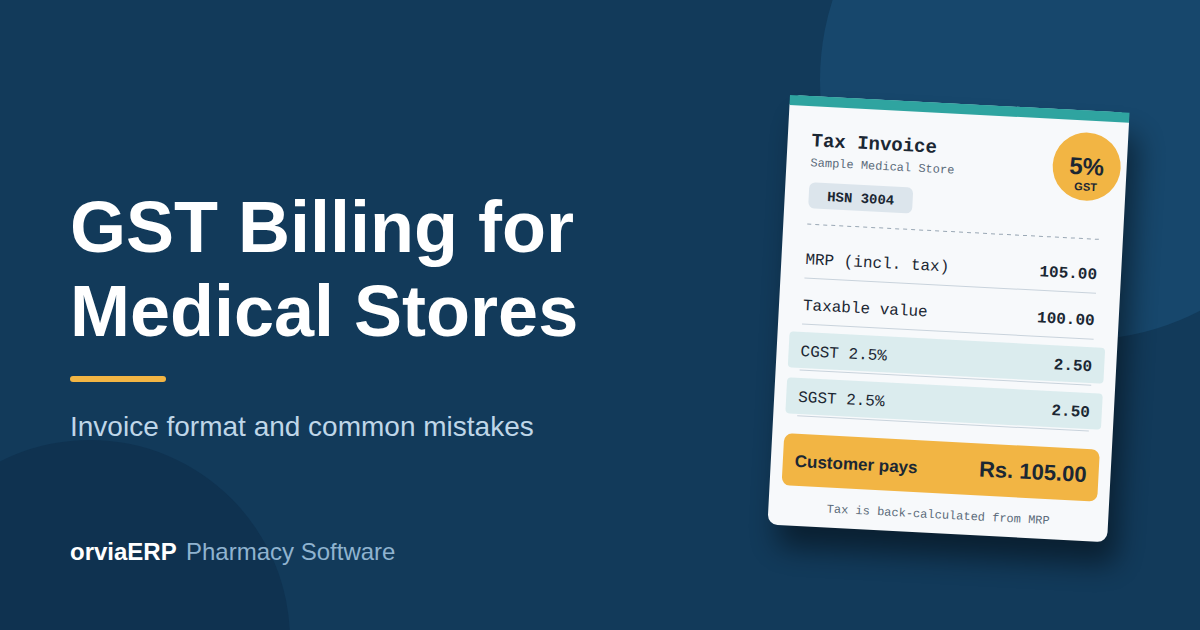
Example: A strip has an MRP of Rs. 105 and the GST rate is 5%.
- Taxable value = 105 / 1.05 = Rs. 100
- GST = Rs. 5, split into CGST Rs. 2.50 and SGST Rs. 2.50
- Customer pays Rs. 105
If you give a discount, the invoice should show it clearly and the tax should be calculated on the discounted taxable value, as per your CA's guidance. Doing this by calculator at the counter is slow and error-prone, which is exactly where software helps.
8 common GST billing mistakes chemists make
- Using an old GST rate. After a rate revision, some stores keep billing at the previous rate for weeks, which creates a tax mismatch.
- One rate for every product. Medicines, supplements and cosmetics need separate rates.
- Adding GST on top of MRP. This overcharges the customer and breaks the MRP rule.
- Missing or wrong HSN codes. This can cause errors in GSTR-1 and invite questions during scrutiny.
- Gaps or duplicates in invoice numbers. Invoice numbers should run in a clean sequence.
- Not entering purchase bills properly. If a distributor's purchase invoice is not recorded, you may lose input tax credit.
- Wrong tax split for interstate sales. Within the state it is CGST plus SGST. Across states it is IGST.
- Sales and returns not matching. Credit notes for sales returns must be recorded, or your declared sales will not match reality.
Keeping your GST returns clean
Good billing makes return filing easy. Aim for these habits:
- Record every purchase invoice on the day it arrives.
- Check your purchase data against GSTR-2B before claiming input tax credit.
- Reconcile your sales report with GSTR-1 before filing.
- Keep credit notes and debit notes in the same system as invoices.
- Share an exportable sales and purchase report with your CA every month, not once a year.
How GST billing software for chemists helps
Good pharmacy billing software handles the repetitive tax work for you:
- Rate and HSN per product. Set it once, and every bill uses it correctly.
- Automatic back-calculation from MRP. No calculator, no mistakes.
- CGST, SGST and IGST split based on the customer's state.
- Sequential invoice numbers with no gaps or duplicates.
- B2B and B2C billing with GSTIN capture for registered customers.
- Sales returns and credit notes linked to the original invoice.
- GST reports ready for your CA, including sales, purchases and tax summaries.
- Quick rate updates. When a rate changes, you update it centrally instead of editing every bill.
The result is faster billing at the counter and cleaner books at the end of the month.
A quick GST checklist for your shop
- Is the correct rate set for every product, including supplements and cosmetics?
- Does every invoice carry GSTIN, drug licence number, batch, expiry and MRP?
- Are purchase invoices recorded on time?
- Do your sales report and GSTR-1 match?
- Does your CA receive reports every month?
If any of these is a "no", that is where your next GST problem is most likely to come from.
How Orvia helps
Orvia's pharmacy software brings GST billing, batch and expiry details and MRP-based invoicing into one counter-friendly screen, built for Indian medical stores. You can test it with your own products in the free trial and see how your invoices and GST reports look before you decide.
Final thoughts
GST compliance for a medical store comes down to three things: the right rate on every product, a complete invoice, and clean records that match your returns. You can manage these by hand, but every manual step is a chance for a mistake. Automating them at the billing counter saves time and protects you in an audit.
Want GST-ready billing at your counter? Explore the Orvia pharmacy software or WhatsApp us on +91 7007761116.