
A medical store is one of the most stable small businesses in India. People need medicines every day, in good times and bad, and a trusted neighbourhood chemist builds loyal customers over years. But unlike a general shop, you cannot simply rent a space and start selling. Medicines are regulated, and a few legal steps must be in place first.
This guide walks you through how to start a medical store in India, step by step: eligibility, licences, premises, stock, billing software and the costs to plan for. Rules and fees differ from state to state, so always confirm the latest details with your state drugs control department before you apply.
Step 1: Understand who can open a medical store
The good news is that you do not have to be a pharmacist yourself. The owner can be any adult who meets the legal requirements. The important rule is this: retail sale of medicines must happen by or under a registered pharmacist who is present during working hours, and the drug licence is granted on the basis of that pharmacist.
A registered pharmacist is someone holding a D.Pharm or B.Pharm qualification and registered with the State Pharmacy Council under the Pharmacy Act, 1948. If you are not a pharmacist, you will need to employ one, and the application will need their certificate, registration proof and appointment papers.
Step 2: Choose the type of store
The most common choice is a standalone retail medical store. Others include a store attached to a clinic or hospital, a franchise store, and a combined retail and wholesale store. Your choice decides which licence you need and how much space you need.
- Retail licence: for selling medicines directly to customers.
- Wholesale licence: for supplying medicines to other shops and institutions.
- Retail plus wholesale: both licences, with a larger minimum area.
Most first-time owners start with a retail licence.
Step 3: Find suitable premises
The usual minimum floor area is 10 square metres for a retail store, and 15 square metres if you hold retail and wholesale licences on the same premises. You will also need a refrigerator for medicines that require cold storage, along with proper shelving and a clean, well-ventilated space.
When picking a location, think about:
- Footfall near clinics, hospitals, residential societies or main roads
- Visibility and easy parking
- Competition within a short walking distance
- A rental agreement or ownership proof, which you must submit with your application
A location near a few clinics and a large residential area usually beats a prime shop on a busy road with no regular medicine demand.
Step 4: Apply for the drug licence
The core licence for a retail medical store is the retail drug licence. In simple terms:
- You apply in Form 19 to your state drugs control authority.
- The licence is issued as Form 20 (general drugs) and Form 21 (drugs covered under Schedules C and C1).
- A drug inspector visits the premises to check the area, storage and pharmacist details.
Typical documents include:
- Identity and address proof of the owner or partners
- Photographs and a layout of the premises
- Rental agreement or ownership proof
- Registered pharmacist's certificate, registration and appointment letter
- Affidavit and declaration forms
- Fee payment receipt (the fee differs by state)
The exact list and the portal you use depend on your state, so check your state drugs control website before you start.
Step 5: Complete the other registrations
Besides the drug licence, a medical store usually needs:
- GST registration, so you can issue tax invoices and claim input tax credit
- Shop and establishment registration from your local authority
- A business registration, such as a proprietorship, partnership or company, depending on how you want to run it
- A current bank account in the business name
- FSSAI registration, if you plan to sell food supplements or health drinks, as applicable
Your CA can guide you on the best structure and the right GST setup.
Step 6: Plan your investment
The total cost depends heavily on your city, shop size and stock levels. Instead of guessing a single figure, plan for these heads:
- Security deposit and rent for the premises
- Interiors: shelves, counter, lighting, refrigerator and signage
- Opening stock: usually the biggest item
- Licence and registration fees
- Pharmacist salary every month
- Computer, barcode scanner and printer, plus billing software
- Working capital for the first few months, since sales take time to build
Keep a buffer. New stores often need several months before the daily sales stabilise.
Step 7: Buy stock the smart way
Opening stock is where many new owners go wrong. They over-order slow-moving items and run out of fast-moving ones.
- Start with fast-moving everyday medicines: fever, cold, acidity, pain relief, diabetes and BP medicines.
- Build relationships with two or three reliable distributors rather than many.
- Ask about return policies for near-expiry stock before buying.
- Check expiry dates on every batch you receive.
- Add slow-moving and specialised items gradually, based on what customers actually ask for.
Step 8: Set up billing and inventory software from day one
This is the step most new owners postpone, and later regret. Setting up proper software from the first day gives you:
- GST-ready invoices without manual calculation
- Batch and expiry tracking, so you do not lose money on expired stock
- Schedule H and H1 records captured during billing
- Customer credit (udhaar) ledgers
- Stock and reorder reports so you buy only what sells
Starting with software is much easier than moving from a notebook after two years of messy records. A tool like Orvia's pharmacy software is built for Indian medical stores and helps you stay organised from the first bill.
Step 9: Launch and build trust
Once the licence is in hand and the shop is set up, focus on what builds a medical store over time:
- Keep the registered pharmacist available during all working hours.
- Never sell prescription-only medicines without a valid prescription.
- Keep stock fresh and check expiry regularly.
- Offer home delivery to nearby customers, if you can manage it.
- Be consistent on pricing and honest on advice.
Trust is the real asset of a chemist. People return to the store where they feel their medicines are safe.
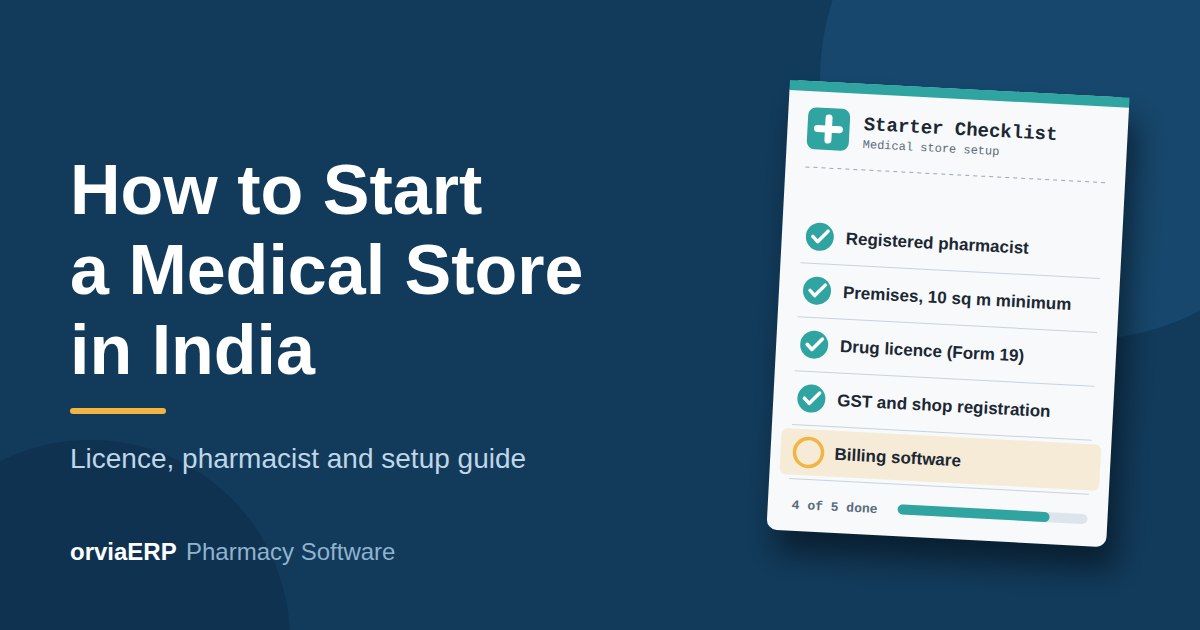
A quick starter checklist
- Registered pharmacist identified and agreed
- Premises of the required size with a refrigerator
- Drug licence applied for in Form 19
- GST, shop and establishment, and business registrations done
- Two or three distributors finalised
- Billing and inventory software ready
- Working capital set aside
Final thoughts
Opening a medical store takes planning, but it is a clear, well-defined process: a registered pharmacist, suitable premises, the drug licence, the other registrations, smart stock and good software. Get these right and you are ready to serve your neighbourhood from day one.
Planning a new medical store? See how the Orvia pharmacy software can handle your billing, expiry and records from the very first day, or WhatsApp us on +91 7007761116.