
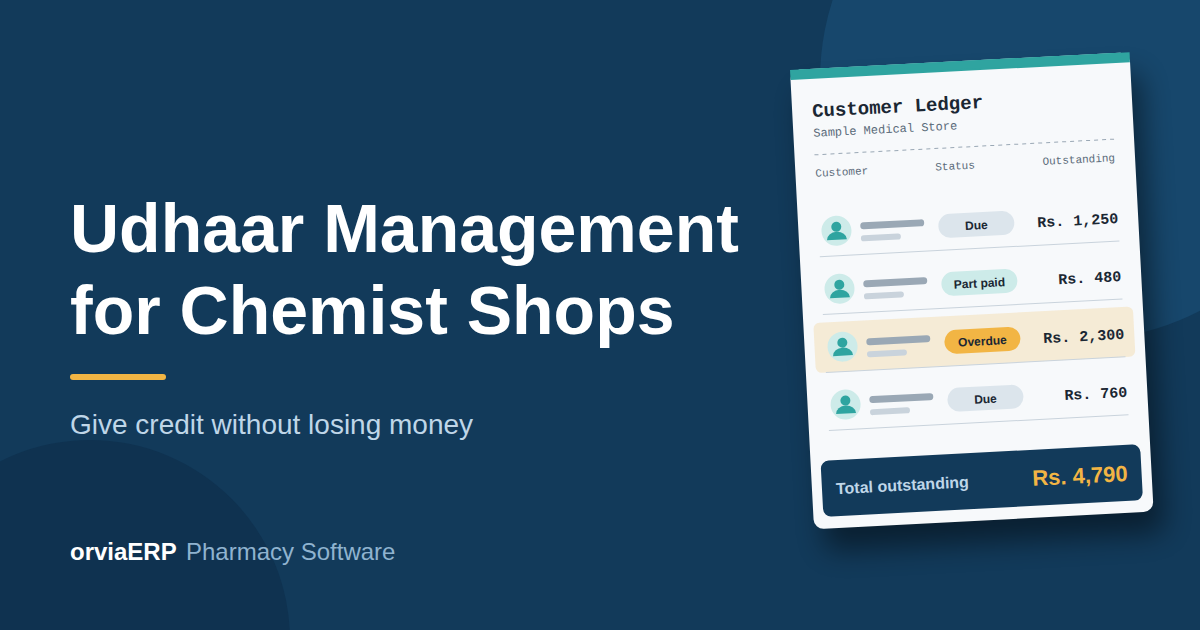
In most Indian medical stores, udhaar is part of the business. The regular customer who buys monthly medicines for his parents, the nearby clinic that picks up stock and pays at month end, the elderly neighbour who forgets her purse. Saying no every time feels wrong, and it can cost you good customers.
But udhaar that is not tracked quietly eats your profit. A few thousand rupees here and there, written in a notebook that nobody checks, can add up to a serious cash flow problem. This guide explains how to handle medical shop credit management in a simple, practical way, and how software removes most of the headache.
Why udhaar hurts a medical store more than other shops
Pharmacy margins are thin. When you sell a medicine on credit, you have already paid your distributor, often within a short credit window. If the customer pays late, you are effectively funding their medicines from your own pocket.
Three things make it worse:
- Medicines are repeat purchases, so one unpaid balance often grows into a bigger one every month.
- Notebook records get lost, smudged or disputed. Without proof, recovery becomes awkward.
- Relationships are personal. Asking a long-time customer for money feels uncomfortable, so many shopkeepers delay it until the amount is large.
Good credit management is not about being strict. It is about being clear, consistent and organised, so that you never have to be awkward.
Step 1: Decide who gets credit and how much
Not every customer needs the same terms. Divide your credit customers into simple groups:
- Regular family customers who buy monthly for chronic conditions
- Clinics, nursing homes and small hospitals that buy in bulk
- Occasional customers who ask for credit in emergencies
For each group, set a credit limit and a payment window, for example a monthly cycle for regulars and a fixed number of days for institutions. Write these down, so you are not deciding from scratch every time someone asks.
Step 2: Record every credit sale properly
A credit sale should be recorded with the same care as a cash sale:
- Customer name and phone number
- Date, bill number and amount
- Items sold, with batch and expiry
- Any advance or part payment received
A notebook entry like "Sharma ji, 450" is not enough. If there is a dispute, you want to show the exact bill, the items and the date.
Step 3: Keep a ledger for every customer
Each credit customer should have their own account showing:
- Opening balance
- Bills raised
- Payments received
- Current outstanding
This lets you answer the question "how much does this customer owe me?" in seconds, not minutes. It also lets the customer see a clear statement, which makes recovery smoother.
Step 4: Follow up on a fixed schedule
Most unpaid credit is not deliberate. People forget, or they wait to be reminded. Build a routine:
- A friendly reminder a few days before the due date.
- A polite follow-up on the due date by WhatsApp or phone.
- A direct conversation if the payment is a week or more overdue.
- A pause on new credit until the old balance is cleared.
The pause matters most. Continuing to give fresh credit to someone who has not cleared old dues is how small balances turn into large write-offs.
Step 5: Accept part payments and write them down
A customer who cannot pay the whole amount may still pay part. Take it, record it, and show the new balance on a bill or message. This keeps the relationship healthy and reduces the chance that a small balance becomes "too awkward to ask about."
Common udhaar mistakes to avoid
- Giving credit without a phone number on record
- Not setting any limit, so balances keep growing
- Mixing cash sales and credit sales in the same notebook
- Forgetting to record part payments
- Waiting for months before asking for dues
- Giving credit on Schedule H drugs without keeping the prescription and register entries in order
- Never reviewing the list of outstanding customers
A good habit is to review your top 10 outstanding balances every week. It takes five minutes and prevents most surprises.
How software makes credit management easy
A notebook can record udhaar, but it cannot remind you, total it, or warn you when someone crosses their limit. Pharmacy software can:
- Customer-wise ledger. Every credit bill and payment is linked to the customer automatically.
- Outstanding report. See who owes what, sorted by amount or by how overdue they are.
- Credit limit warnings. The software can alert you when a customer is about to cross their agreed limit.
- Part payment entry. Record partial payments in seconds, and the balance updates instantly.
- Payment reminders. Send a reminder with the amount due by message instead of calling each person.
- Statement for the customer. Share a clear statement of bills and payments to avoid disputes.
- Link to the actual bill. Every entry connects to the original invoice, with items, batch and date.
This turns udhaar from a worry into a routine report that you check once a week.
A simple weekly udhaar routine
- Monday: open the outstanding report and note the top 10 balances.
- Midweek: send reminders to customers whose payment is due or overdue.
- Friday: record all payments received and check that balances match.
- Month end: review total outstanding and decide whether any customer's limit needs to change.
Ten minutes a week is usually enough to keep credit under control.
How Orvia helps
Orvia's pharmacy software keeps credit sales, customer ledgers and outstanding balances inside the same billing system you use at the counter, so there is no separate notebook to maintain. You can set it up with a few of your regular credit customers and see how the outstanding report looks.
Create your free account and try it here.
Final thoughts
Udhaar will always be part of running a neighbourhood medical store, and that is fine. What matters is that every rupee of credit is recorded, limited and followed up. With clear terms, a proper ledger and a weekly routine, you can keep your regular customers happy and still protect your cash flow.
Ready to stop chasing notebook entries? Sign up for the Orvia pharmacy software or WhatsApp us on +91 7007761116.